


It’s an entirely familiar tale in heart failure care: A patient is evaluated, reports feeling stable, and within days is rushed to the ER. As this cycle repeats across clinics and hospitals nationwide, providers continue to face a persistent challenge: Understanding why readmissions remain high.
But how does a patient who seems fine one day, end up in the ER shortly after? Visibility into lung fluid levels can help clinicians answer that question while providing a treatment roadmap that allows heart failure care to be implemented before symptoms get worse vs. only after they present in patients. That visibility has historically been limited by the tools available to assess pulmonary congestion in clinical settings, but recent innovations using remote dielectric sensing (ReDS™) have opened up new opportunities across the continuum of care.
How Reactive Heart Failure Care Sells Patients and Clinicians Short
Heart failure affects more than 6.2 million people in the United States and remains a chronic condition with no known cure.1 Measuring congestion levels is one of the most important diagnostic tools in heart failure care, helping stave off decompensated heart failure. Tools currently used to conduct lung fluid level monitoring include chest radiography (CRx) and natriuretic peptides (NPs) measurement, which can’t be used outside clinical settings.
Physical exams are also part of the diagnostic process, evaluating for external signs of pulmonary congestion, including shortness of breath (dyspnea), swollen veins in the neck (jugular vein distention), swollen legs or ankles (peripheral edema), pulmonary crackles, and enlarged liver (hepatomegaly).2
Unfortunately, many of these symptoms are also hallmarks of other issues. Dyspnea, while the principal symptom that can indicate pulmonary congestion, is also a common feature among many cardiac, respiratory, and systemic diseases.
Peripheral edema is frequently associated with abnormally low levels of protein in the blood (hypoproteinemia), hepatic, and renal disorders. Bilateral leg edema can present as a side effect to dyidropiridine, a widely-used treatment for hypertension and coronary artery disease. And pulmonary crackles do not present as early phases of decompensation.2
Pulmonary crackles are one of several symptoms that become more salient as symptoms worsen. Relying on these as preliminary indicators helps ensure that the cycle of hospital admissions and readmissions continues on unabated. This overreliance on symptoms is needed makes heart failure care more reactive than proactive, as congestion can build before symptoms clearly escalate.
Recent updates in pulmonary assessment technology offer a better way to determine lung fluid levels beyond symptoms, an objective gold standard that empowers clinicians to make more definitive decisions about the best treatment course. Objective lung fluid measurement gives clinicians a number to act on, helping care teams identify risk earlier, adjust treatment sooner, and support a more proactive approach to chronic disease management.
Towards a Gold Standard in Pulmonary Congestion Assessment
Remote dielectric sensing offers a more direct, and flexible approach to conducting pulmonary lung fluid measurements at the point of care. Sensible Medical’s groundbreaking ReDS™ Pro System delivers clear, objective lung fluid measurements in just 45 seconds.
ReDS is a fast, quantitative way to measure lung fluid; ReDS-guided management was associated with reduced heart failure hospitalizations in a published study, reducing hospitalizations by 87%, with other studies showing as high as a 91% reduction in readmissions.3
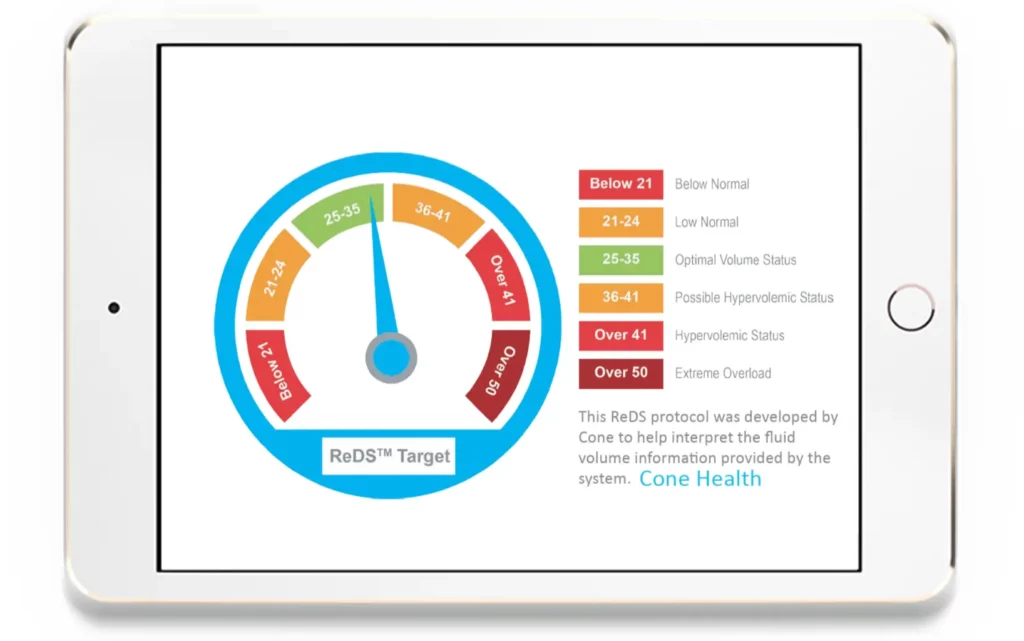
Subsequent studies have revealed that ReDS-guided therapy after HF hospitalization with lower 30-day readmission risk; ReDS measurements led to medication adjustments in many patients.4 The point-of-care lung fluid measurement device uses radio frequency technology to evaluate the dielectric properties of lung tissue and assess lung fluid content noninvasively. Once placed on the patient, ReDS measures the percentage of fluid build up in the lungs, indicating euvolemic (optimal) fluid status.
Readings outside the optimal range can guide treatment decisions, supporting protocol-driven care across emergency departments, inpatient settings, and follow-up care.
Elevating Heart Failure Treatment Across the Continuum of Care
The ability to generate actionable information in 45 seconds does more than just help clinicians and patients. Cardiologists can adjust treatment methods like the use of diuretics before symptoms worsen. Caretakers managing high-volume heart failure panels can quickly determine which patients need more intervention while tracking responses to treatment. And hospital systems have a powerful tool they can use to help break the readmission cycle.
For hospital systems, having a way to head off the clearest indicators of acute heart failure is particularly vital. Acute heart failure patients overwhelmingly present high lung fluid levels at admission, as well as at discharge.5 ReDS provides clinically relevant data throughout the care continuum, supporting efforts to reduce readmissions and improve overall quality of care.
Readings using ReDS noninvasive lung fluid monitoring technology provide clinically relevant patient data regardless of where a patient is in the heart failure cycle, impacting both heart failure readmission rates and the overall quality of care.
The ReDS Pro System’s compact, easily portable design further empowers hospital systems and caregivers. Its slim build, non-invasive and lightweight design makes it easy and comfortable to use in just about any setting, from home care through healthcare systems.
Taking the Next Steps
By shifting heart failure away from the existing reactive standard to informed, proactive care management, ReDS gives caregivers an easy, actionable way to measure lung fluid directly.
Schedule a virtual demo to see how ReDS can help your care team adopt patient-centric, data-driven heart failure management at the point of care.
Sources
- Healthline. “Decompensated Heart Failure: What You Should Know.” https://www.healthline.com/health/heart-failure/decompensated-heart-failure#:~:text=Decompensated%20heart%20failure%20%28DHF%29%20means%20that%20symptoms%20from%20heart%20failure%20are%20severe%20enough%20to%20require%20immediate%20medical%20attention.%20Dyspnea%20or%20shortness%20of%20breath%20is%20the%20most%20common%20symptom%20of%20DHF. Accessed April 25, 2026.
- Pirrotta, Francesco, Francesco Mazza, Giuseppe Inserra, Sergio Ricciardelli, Michele Tinto, and Pasquale Perrone-Filardi. “Pulmonary Congestion Assessment in Heart Failure.” Diagnostics 11, no. 7 (2021): 1236. https://www.mdpi.com/2075-4418/11/8/1306
- Amir, O., et al. “Evaluation of Remote Dielectric Sensing (ReDS) Technology-Guided Therapy for Decreasing Heart Failure Re-Hospitalizations.” International Journal of Cardiology 240 (2017): 279–284. https://www.internationaljournalofcardiology.com/article/S0167-5273(16)32225-2/fulltext
- Lala, A. et al. “Early Use of Remote Dielectric Sensing After Hospitalization to Reduce Heart Failure Readmissions.” ESC Heart Failure 8, no. 2 (2021): 1047–1054. https://academic.oup.com/eschf/article/8/2/1047/8381985
- Chioncel, O., et al. “Acute Heart Failure Congestion and Perfusion Status: Impact of the Clinical Classification on In-Hospital and Long-Term Outcomes; Insights from the ESC-EORP-HFA Heart Failure Long-Term Registry.” European Journal of Heart Failure 21, no. 11 (2019): 1338–1352. https://doi.org/10.1002/ejhf.1492
https://pubmed.ncbi.nlm.nih.gov/31127678/